Sunday, March 15, 2015

Formal Film Study: Dark Vietnam War Movies

                         Image result for the deer hunter Image result for apocalypse now Image result for platoon
those of you who don't know me very well, let me start off by telling you something about me. I LOVE history, and have since a kid. So don’t be surprised to see primarily movies that take place in history. Be prepared for a history lesson too.


Over the past year or so, I have been interested in the Vietnam War. I have seen a fair share of movies that take place in or revolve around the war, like Forrest Gump, Platoon Leader, Good Morning Vietnam, and We Were Soldiers just to name a few. When I heard we had to do a formal film study, it finally gave me a reason to watch The Deer Hunter (1978), Apocalypse Now (1979), and Platoon (1986). When I wanted to talk about dark Vietnam War Movies, I didn't just mean the war as being dark. I meant things such as: character development, and setting, and cinematically how it looked.


Image result for the deer hunter
L to R Nick, Michael, Steve

The first thing I noticed between the three was the writing and how completely different are. The Deer Hunter is about a group of friends, three of which, Michael, Steve, and Nick, go off to Vietnam and shows their lives before and after hand. It also shows how Russian Roulette changes their lives. Apocalypse Now, is about Captain Willard who is sent on a mission into Cambodia to assassinate an army colonel named Kurtz. Platoon, is about a Chris Taylor's new platoon (15-30 soldiers) and the differences in the unit ( 25th Infantry Division) and how they pull the new recruits into each groups ideas. How each movies charters treat the Vietnamese is completely different too. In Deer hunter, there was little, Apocalypse had it only when Willard and PBR ( Patrol Boat River) street gang attack the village with the helicopters. While in Platoon, someone said "Gook" or "Charlie" every 3 minutes it seemed.

Now the lighting, as I said before, I wanted to watch dark movies setting wise and each movie had different depictions of darkness. In Hunter, The Dark scenes are the ones at the steel mill, the hunting lodge and Roulette House (Presuming that's what they're called). The steel mill is nothing important, just the boys working. The lodge and house are where the movies are at their darkest both plot and cinematically speaking. In Apocalypse, the majority of the movie is during the day, the dark parts are the last base at the Do Long bridge, and at Kurtz's compound. I believe Coppola used the darkness at the bridge to create even more chaos and to show how the men of Street Gang felt about the mission. Kurtz's Compound because it was supposed to match the darkness in him and the people around him. In Platoon I believe Stone used darkness to show how it created fear in the men during the war and to build and the disorder that usually followed.


The camera work was also something that interested me. All three used different types of shots. Hunter very heavily used far ranged shots. I also noticed that primarily they were primarily in the hunting scenes and shots of Michael's house. The rest of the shots were for the most part medium angle shots used in the Roulette House, Vietnam, and the hunters hut. Apocalypse used a full spectrum like small, medium in large shots. The ones that stood out to me most were the close of of Kurtz( Marlon Brando) and Willard (Martin Sheen). In M. Sheen's face you can see how the events around him leave him sometime unphased and by the end the sheer terror he is in. In Brando's face you can see how sinister and cold he is. Platoon like Apocalypse, used a range of small medium and large shots. The large was always used when the soldiers were walking in patrol or in battle. Medium shots were used in the end. The small shots were used almost entirely on Taylor ( Charlie Sheen). 


Of the characters/soldiers in the three movies, none were the same. Some were gung-ho, some reserved, some nervous, the whole spectrum. It was nice to see the variety that rather than the generic soldier who is one of those three. My favorite of the movies was Chris Taylor. When we first see him, he's new, scared and regrets his decision on coming to Vietnam. By the end, he's mad, running around like an animal, and shoots at everything that. I feel that I would personally be him if I was in Vietnam. I would not be this by choice, I think everyone would be him at the beginning but by the end, I know I would be mad after a terrible year of getting shot at I'd run around like crazy too.


The settings, Much like their stories, were completely different. While Hunter focused on events at home, the other two didn't. At the same time, In Platoon battling the Vietnamese at close quarter wasn't seen in the other movies. All the movies also were almost in all the same place which I thought was interesting. Hunter was Home, Vietnam, and Russian Roulette scenes. Apocalypse was almost completely, Saigon, the PBR, and Kurt's camp. Platoon was The camp, The battles, and nights. Each movie had other scenes, but those were short or unneeded.

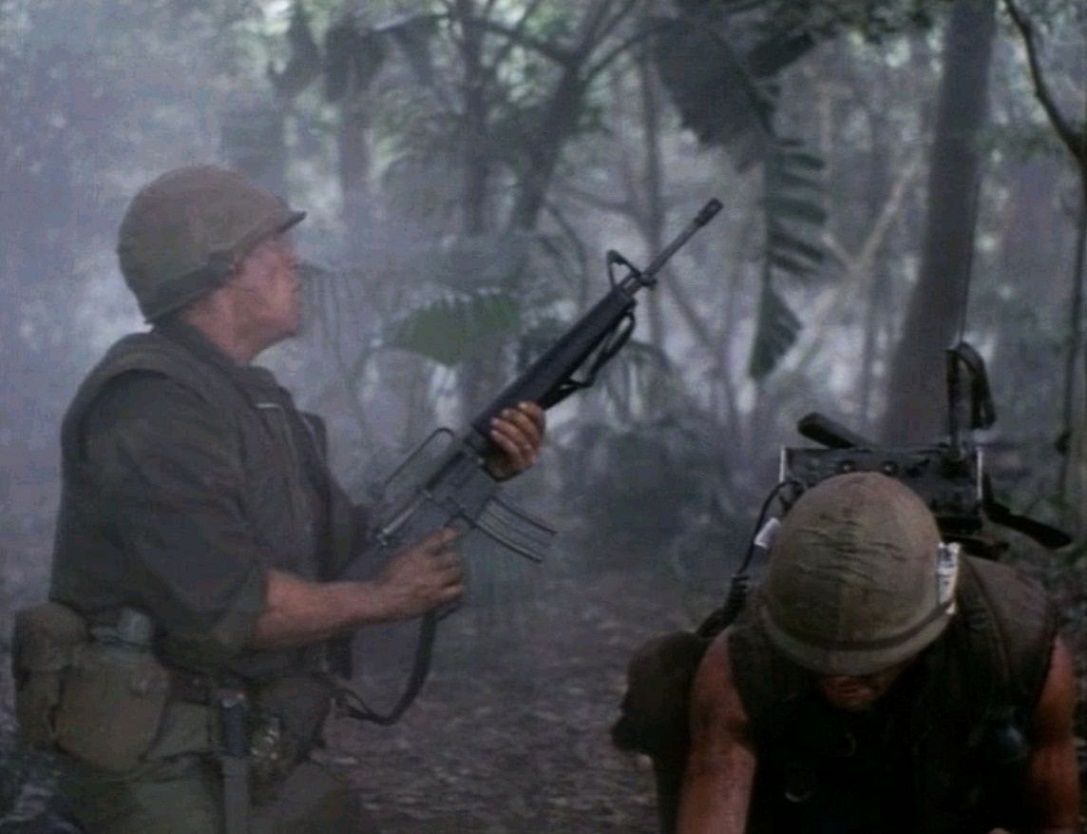
Image result for the deer hunter huntingWhen I watch movies, I like when they can create immersion. I want to feel like I'm hunting deer, or sitting in a boat in the Mekong Delta driving inland, or in a jungle 6,000 feet away from the Cambodian Border. I think all three do a great job doing it, but each movie has a different amount you can get into it. I personally think that Apocalypse and Platoon are the movies that created the most immersion,


The base of these movies, they all have the same common theme, A soldier trying to survive get home. In Deer Hunter, Michael, Steve and Nick all make a pact on trying to get home together. Apocalypse is about to get Kurtz home and the men of PBR Street gang  crave nothing more than home. In Platoon, Taylor and some of the other men doubt that they'll get out alive let alone in one piece. It didn't matter if you were a green beret, sent in on a secret mission or just a basic grunt, everyone wants to go home.  
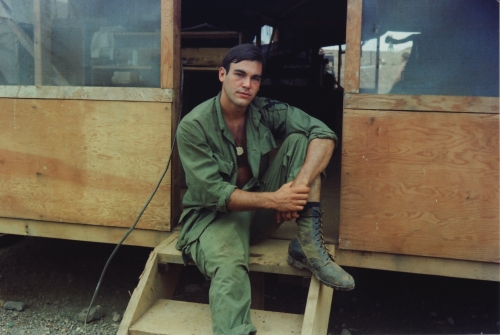

Directer Oliver Stone In Vietnam
Of the three movies, Platoon was my favorite of the three. The movie's plot moved quicker and was more action based which I enjoy more. The Movies Director, Oliver Stone, is also a Vietnam vet, who was with the 25th infantry (Ironic) then the 1st Calvary. He got a Bronze Star and two Purple Hearts. so I believe that Stone's rendition of it is a more accurate one than The Deer Hunter or Apocalypse Now.

Wednesday, March 11, 2015

MYST: #2 Platoon leader


                                  (If this doesn't scream generic 1980's movie nothing does)

For those of you who don't know me very well, let me start off by telling you something about me. I LOVE history, and have since a kid. So don’t be surprised to see primarily movies that take place in history. Be prepared for a history lesson too.

While scrolling on through on Netflix to see if any movies for my FFS was on, I saw this movie on so I figured "What the heck, maybe its a good movie and could work for one of the three movies".

Fresh West Point graduate Lieutenant Jeff Knight (Michael Dudikoff) is sent in as a replacement to take command of Sergeant Michael McNamara's tour veterans platoon (The men are in the 173rd Airborne division) at a Vietnamese trench camp. Lieutenant Knight is greeted by his men who mock, and doubt him due to his lack of combat. Unlike his predecessor, who hid till the end of his tour, Lieutenant Knight takes charge, experiences life outside the manuals, and gets wounded. He returns, fully respect by men and superiors. Besides the Vietcong, the platoon wrestles with protecting villagers, which the GIs fear as some collaborate with the Vietcong.

There were many things I liked and dislike about each. Ill start with the story itself, which was nothing special. While watching it, it seemed generic and I feel bad saying that because its actual based off of a true story. But hopefully like most books turned movies, the book is better.

Another thing I didn't enjoy was the acting. The cast is all nobody's other that Dudikoff, who was just in C grade movies before and after. The soldiers were also generic, The one incompetent leader, the full of himself tool, the nerdy radio operator, the one black guy, the helpful Sergeant... the list goes on and on.

Image result for platoon leader 1988

**History Nerd Alert** I was not very big on how they depicted Vietnam, there was a shot of a Huey flying over, and there is a farm in the shot. Another thing that bothered me was the jungle shots. Now, I'm no expert on jungles, plants, or Vietnam, but it looks as if it was shot in Fullersburg Woods, not a jungle. However the one thing that surprised me was a Scene where Lieutenant Knight trips a trip wire. (it also didn't work the firs time but tugged at it) The average life expectancy for a Lieutenant in Vietnam was 16 minutes, ( Why I know that, I don't know) his injury happens on his first trip into the jungle, showing how accurate that was. 


Something I did enjoy was the cinematography, it had some generic stuff sure, but also things that aren't very common. My two favorite ones were point of view shots and large shots. In most war movies it shows a semi- point of view. Semi meaning it shows a little bit of the soldier in it. But in this, It used a point of view from the soldiers on the hunt for the Vietcong. The Large shots were interesting to because it showed things like the valley there base is in, the enemy or the platoon themselves. The only other movies like this I can think of with any large shots are Saving Private Ryan, and The Deer Hunter which uses it heavily.

One scene I remember was that one of the soldier overdoses on Heroin. This was by no means my favorite scene, but it intrigued me because I have never seen a scene like that even in a Vietnam movie. It also shows how that not everyone in war dies by a bullet.

My favorite scene however was one of the last in the movie where Lieutenant Knight talks to Sargent McNamara and asks about what his job besides protect the village. He says "our jobs is to get people to change their minds. How I see it... everyone's got a business, (lists of some different business) were in the argument business. We sell ideas. and if you can't sell  yours, (Picks up a bullet) you place one of these in their body." I liked this scene because it shows what war is at it simplest, and how it has been for centuries.

Overall, despite its generic story and bad cast, it was somewhat enjoyable . I give Platoon Leader 3 Huey's flying over the treeline out of 5.

Image result for Huey vietnam over treeline

Trailer- https://www.youtube.com/watch?v=DnHbVCzuofc


Friday, March 6, 2015

Create a Movie: Lawless Rider

STUDIO:
20th Century Fox. Known for socially-conscious adventure films and “hokey cheesey ‘Americana’.” Worked with Ford and Wayne.   


CAST/CREW:
Director: John Ford
A well known Director working in the 30's, made a lot of westerns, frequently worked with John Wayne and worked with Bert Glennon on Stagecoach in 1939.


Cinematographer: Bert Glennon
Received the Academy Award for Best Cinematography (Black & White) for Stagecoach in 1939


Actors: John Wayne, Alice Faye
John Wayne is a quintessential Western movie star that works with John Ford and Fox.
Faye also worked with Fox and was considered very popular and attractive.


GENRE:
Western. Audience familiarity. Escapism from the 30's. Cultural critique against banks/wealth.
The idea of the rugged individual can comfort the poor conditions of the great depression. The themes of justice are of interest to a bank-hating public.


SYNOPSIS:
The movie begins with Charles (Wayne) and a group of five rugged bandits looking upon a fairly large mansion on a grassy knoll. As conversation begins to develop, it is learned that the group is there to ransack the mansion for all it’s worth, and it appears that Charles is the ringleader for tonight. Charles explains that the rich couple that owns the house is out for the night, and won’t be back until late in the evening. After a few more gloss overs of the plan, the band separates to get in through the three different entrances, each man at an entrance carefully picking a door open. Once the men are in the building, all is well, until Charles discovers a girl cowering in her closet in one of the upstairs bedrooms. Charles quickly notices that the girl has made a phone call and assumes that it was to the police; seconds later, law enforcement has arrived, and, not yet spotted, Wayne snatches the girl and bolts out of the building, riding off into the night on horseback. It is explained that the girl’s name is Margaret, (Faye) and Charles says the intention of the kidnapping was for some sort of ransom. He explains that he’s not going home without any money. After several escape attempts by Margaret, the two are attacked by a group of bandits looking for loot. Charles ends up fighting them off, and becomes a sort of protector to Margaret, no longer seeing her as a tool for money. As the relationship between the two grows as they continue journeying, Margaret expresses her desire to live in Sacramento. Charles agrees, and after a long and arduous journey, is met with law enforcement officials who know his face. After a solitary respite in a town shop, Margaret is alerted to the sound of gunshots. As she runs outside, she finds Charles dead on the ground, having killed two officers before being gunned down. *Note: it is never made clear whether Margaret loves Charles back or not, just that the hostility fades and she’s complacent with being with him/enjoys his company. It is possible that she loves him, but that’s up to viewer speculation.


HAYS CODE:
Considering the movie follows an anti-hero turned hero, it’s fairly hard to make judgement calls on what’s appropriate and what’s not. However, our character is initially portrayed as a morally detestable person, one that audiences will struggle to support or relate with. Until the point where Charles begins his change of character, the actions committed are frowned upon, due to the law winning in the end over the bandits.  As the relationship between Charles and Margaret develops and the audience begins to identify with Charles, his actions will have the audience rooting for good causes, like protecting someone special. However, in order to make the movie a real moral tale, Charles death informs the audience that a life of crime doesn't just fade away, no matter how much you do to wipe it clean. Charles will always be an enemy in the eyes of the law: his actions have already defined him.


TECHNOLOGY:
Black and White film. Common for 30's Westerns. Stagecoach was black and white and was made in 1939… received award for best cinematography.

IF I COULD HAVE DONE ANYTHING DIFFERENTLY:
I wouldn't have chosen the title we ended up with. I guess it's kind of cool to have the whole generic western thing turned on it's head by the end of the film, but it made me feel like I had to joke about it. It worked out though, didn't it? I'm still struggling to figure out how.

Sunday, February 15, 2015

MYST: #1 Inglorious Basterds

MYST #1: Inglorious Basterds
For those of you who don't know me very well, let me start off by telling you something about me. I LOVE history, and have since a kid. So don’t be surprised to see primarily movies that take place in history.

While at a friends a few weeks ago, we were flipping through some channels and we saw that the last bit of the movie was on. It was still just as funny even seeing all the movie again. When I first heard of I thought it would be a “Saving Private Ryan” or “The Dirty Dozen” type of film. Boy was I wrong. Quentin Tarentino made this into a War and comedy movie the only like of which can match Robert Altman’s M*A*S*H*.

** Spoilers alert**
It's WWII in Nazi occupied France. The Nazis are exterminating Jews, the most prolific Jew hunter is SS Colonel Hans Landa (Christoph Waltz). The U.S. Army makes a unit, led by Lieutenant Aldo Raine (Brad Pitt) comprised of eight Jews, to kill as many Nazis as possible. Raine tells each of his men to bring him the 100 Nazi scalps. He has his own method of ensuring that those Nazis he does allow to live. In Paris, Joseph Goebbels (Hitlers Chief of propaganda)  plans to debut his latest film, "Nation's Pride". The film, based on the victorious military exploits of Private Fredrick Zoller (Daniel Bruhl), during the battle Sicily in 1943.  Because of his attraction to its pretty proprietress Emmanuelle Mimieux (Melanie Laurent), Zoller convinces Goebbels to have the premiere at Mimieux's cinema. Landa is to act as chief of security for the event. When the Americans get wind of the screening and the fact that most of the Nazi leaders will be in attendance, Raine's team is tasked with blowing up the cinema during the screening. They are assisted by renowned German actress, Bridget von Hammersmark (Diane Kruger), who has been working as a spy for the British. They believe luck is on their side when they learn that Hitler himself is scheduled to attend. Beyond being found out, Raine's team face two issues. The first is Mimieux, who is Shoshanna Dreyfus, a Jew who saw her family brutally murdered by Landa four years earlier and has her own plans for the Nazis. The second is Landa, who has another more personal mission for his life post-war.

One thing that stuck out to was how innovative it was. Like I mentioned before, it a lot like M*A*S*H*, the movie has the theme of comedy in war as well as out right ridiculousness. This however takes them and makes them extreme. Like the extreme gore Tarentino is known for and for jokes about killing Nazis for example. Or when the "Bear Jew" More or less plays baseball with a Nazi's head As a person who enjoys history, I liked how accurately it was portrayed. There were a few points that weren't obviously, but that made the movie funnier to me. The war element is very present to because there are things you would see in a World War Two movie, blood,  tanks,  Hitler, Soldiers fighting and the list goes on .

Another thing that I really enjoyed was the acting for the movie. Normally, I don't care who plays who or judge people based off of their experience or skill. But this movie had a smorgasbord of variety from little known actors like Eli Roth and Til Schweiger to more well-known actors like Brad Pitt and Diane Kruger. It also has great cameos by people like Quentin Tarentino himself and Vince Vaughn just to name a couple.


I give this move 5 Basterds out of 5!

   Image result for Is a basterd